

One of the most influential yoga teachers, Judith Hanson Lasater, once said: “Yoga is the practice of making difficult choices.” The difficulty, I believe, lies in the mentality of familiarity. Over a lifetime, our perspective narrows until the usual way, the familiar way, “the way my parents did it,” feels like the only way available. *
We stop seeing possibilities.
Change feels daunting.
We feel trapped in the “what is”, frustrated by the lack of options.
Natalia Bekhtereva, a brilliant Russian neuroscientist and psychologist, the founder of Institute Of Human Brain, wrote, “Healing can only occur once the matrix of disease-causing thinking is broken.”
So how do we change our minds? Can we break out of the straight jacket of disease- causing thinking?
In last week’s blog post I talked about life’s little challenges, and how we can turn those challenges into big opportunities to confront the all too familiar patterns of thinking and being. The “Choosing Differently” series is an invitation to delve deeper into the nitty-gritty of the process. Each week you’ll meet one of my students and witness their AHA yoga moments and life’s little victories, as we explore fresh and unfamiliar approaches to annoying/ life-disruptive issues.
Meet this week’s “choosing differently” hero – we’ll call her Anna**.
Anna is a very active young teacher – she runs, bikes, skies, snowboards, plays soccer, and practices yoga. She also lives with persistent back pain. Over the past 3 years we worked through some postural and structural imbalances; I also referred Anna to a great physiotherapist. All of those interventions helped some: Anna has gained a lot of body awareness; however, the pain is still there.
Anna’s usual approach is to grit her teeth and power through. She prides herself on being active and busy, and avoids idle time by all means possible.
Anna comes to Yin & Yang class on a weekly basis. She loves the active flow of yang practice; it is the longer-held stretches of yin yoga that she finds testing. She struggles to hold still, her body constantly shifting to relieve a pressure point here or there, and mental focus zooming from back pain, to wrist discomfort, to that knot between her shoulder blades, to what the other students in the room are doing.
During the private session we looked at some poses that Anna found particularly tricky. In the group class Anna tries hard to block her body’s complaints out of her mind. Breathing forcefully is the usual go-to strategy: drowning discomfort in the breath seems like one of the very few options available. Instead, I invite Anna to listen.
“What do you feel in your body?” I ask.
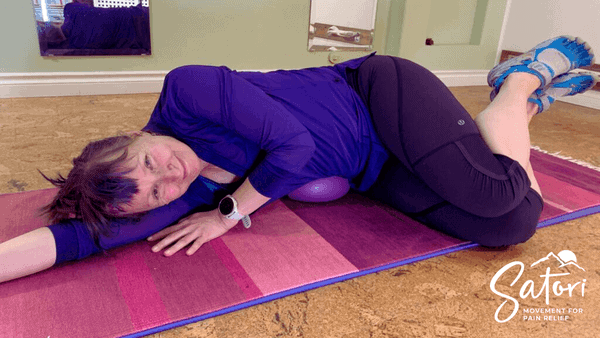
Responding to her body’s needs, we shorten the stance in the deep lunge pose; extra padding under the back knee eases (not forces!) hip flexors into a stretch; blocks under the hands soothe the wrists; supporting the head allows mid-back to relax.
And then the magic happens: Anna’s breath smoothes out; her body suddenly looks quiet; there is a sense of tranquility reminiscent of still point in cranial-sacral work. These are poignant moments. Every once in a while I get the privilege to witness a moment such as this: stillness so profound, it is as though the whole room is imbued with the luminous quietness of human being.
“How does this feel?” I inquire after some time.
“ Peaceful…” Anna replies.
Our game plan for the future – yoga mat first, “real life”*** second:
~In the yoga pose listen to your body: avoid pushing discomfort out of the way or trying to overpower it with the breath. Just listen.
~Make adjustments and use props to ease your body into a pose. Slow down. Ask questions.
~ Monitor your mind’s reactions to changes you are making in the posture, and also to the fact that your posture looks different than the rest of the class.
Can you think how you can use these strategies in your yoga practice?
What about “real life”?
* TV, social media, and cultural conditioning play a huge role indoctrinating our beliefs and behaviors into acceptable norm. This is a vast topic onto its own, to be explored somewhere down the road. You’ll hear me rant about it periodically in class☺
** Students’ names are changed for privacy.
*** There’s a saying in the yoga world, and it goes something like this: “ Mat is the microcosm of your life: what you do on the mat and off the mat are inseparable.” I’ll let you be the judge of that.
