

I’ve received so many phone calls and e-mails asking me about sacrum and SI joint (and the pain that often comes with the imbalance in this area), that I thought I better address them all in one place – and in writing.
This post is going to be a long-ish one {there’s a lot of territory to cover, no pun intended} so maybe grab a cup of tea before you settle down to read it.
Settle down carefully, that is: sitting is one of those activities that can accentuate the instability in SI joint and make the pain worse.
So, what’s with the name? And where exactly is the sacrum?
The word SACRUM, as it turns out, has the same Latin root as “sacred,” so the name roughly translates into a “holy bone.” There’s a bit of history attached to why it is named so, but I am going to leave that out – I think relating to one of our back bones as “sacred” is a great enough place to start.
Imagine your spine as a downward pointing arrow (well, a rather curvy downward pointing arrow.) Sacrum is the arrowhead at the bottom of the spine.
Essentially, sacrum is a continuation of the lumber spine, consisting of roughly five vertebrae that are all fused together into one rigid downward pointing triangular bone whose endpoint is the tailbone.
Now imagine that this arrow point is wedged – and tightly so – between 2 bricks. The sacrum is not only part of the spine, but also the keystone – like a wedge- between the spine and pelvic bones (also called “the ILIA”).
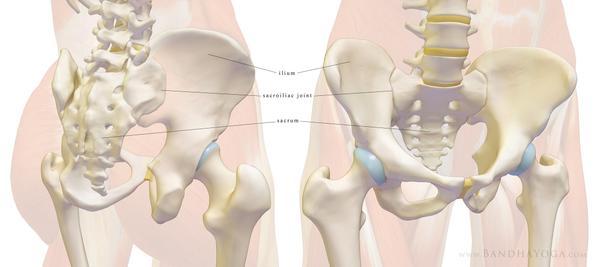
On the left and right side of the sacrum, where it meets the pelvic bone – or ilia – are two joints. Because these two connect the Sacrum and the Ilia we call them SI – or sacroiliac joints.
Here, have a look at the image – it will make more sense than all of my words combined:
What do SACRUM and SI joints do?
Now that we’ve covered where it is, let’s talk about why it is there and what SI joint does. Luckily for the length of this broadcast, this part is pretty short and straight forward: SI joints are body’s shock – absorbers.
Through these joints, much of the weight of the torso is transferred to the pelvis and the legs, and when we walk, these joints help to transmit the force of impact of our steps upward into the body and diffuse it.
SI joint moves very slightly as we move to help us maintain our balance and center of gravity. SI joint disorders – and pain that comes with them – occur when sacrum moves either too much or too little ( or, more often, too much on one side, and too little on the other) – to distribute the forces efficiently.
While the movement here is quite small – SI joints are built for STABILITY, not MOBILITY – it is crucial to the health of the pelvic girdle.
This area contains a lot of nerves so even a tiny unevenness in the mechanics here can cause irritation to the nerves of the sacrum and lumbar spine. Consequences of small misalignments here reverberate all the way through the spine and pelvis.
For women, hormonal fluctuations, pregnancy and delivery all have destabilizing effect on pelvic girdle, and more specifically on sacrum and SI joints. Sacrum also moves through series of very precise positions during certain parts of labor, potentially amplifying the already inherent instability for some of us.
This can explain why – by some estimations close to 80% – of women struggling with low back pain have some degree of SI joint dysfunction.
What are the symptoms of SI joint dysfunction – where would I feel it?
Let me start by saying that according to some surveys and studies that attempted to quantify the burden of SI joint dysfunction, this particular condition seemed to be more debilitating than asthma and mild heart failure, and as debilitating as chronic depression or severe, progressive lung diseases.
Those of you who are familiar with SI joint pain (myself included) are probably nodding your heads in agreement. Plain English: SI pain sucks.
For majority of people the first symptom of SI joint dysfunction is lower back pain (more often one-sided), but there can also be pain in the buttocks, groin or thighs, as well as pins-and-needles sensations in the hip or groin, or increased urinary frequency.
Instability in sacrum or SI joints can also compress sciatic nerve with all ensuing symptoms of a full blown sciatica (I had that 2 winters ago. No. Fun.)
You might have a sense of feeling uneven or lopsided.
Movements such as going up or down the stairs, or even walking on an uneven surfaces, can be aggravating.
Sitting, which “unlocks” the SI joints – making the sacrum a less stable weight bearing wedge – can worsen the pain as well.
And now the BIG question: what can I do to help myself?
A general rehab flow builds (and, sometimes, circles) along these lines – I am condensing here as much as I could – this post is already waaay too long:
1. Manage pain.
This is a foundation of everything that there is to come – without that foundation your body will continue to grip, tighten and wrestle its way through a limited range of compensated movement patterns, bracing every time you prepare to move.
There are multiple techniques and strategies to manage pain – from medication to pain care yoga. Usually, a combination of different strategies works best.
2. Rebuild awareness of how you move.
Often, the instability in SI joint correlates almost directly with the lack of mobility / awareness in the hip joint.
If you recall from earlier, SI joints are built for stability.
Hip joint is quite the opposite – it is built for mobility.
When we cannot find the regular every-day movements such as walking and sitting at the hip joint – where they belong – we move at SI joint instead.
3. Release tension, lengthen the muscles.
Sacrum is stabilized through a number of ligaments as well as musculature around the pelvis. When these ligaments grow loose – such as during pregnancy and after childbirth, for example – our stability largely depends on the muscles here.
Often, the SI joint disorders are a direct result of muscular imbalance between the muscles of the buttocks at the back, front thigh and hip muscles (quads and the hip flexor group), pelvic floor muscles down below (between the tailbone and the pubic bone), and lower abdominal muscles between the belly button and the pubic bone.
4. Build strength.
This is pretty self-explanatory.
The only one thing I’d add is this: unless you have actively worked on rebuilding awareness of how you move and rehabbing your movement patterns, you are going to build yourself a tighter and tighter cage of tension on the top of already existing poor movement patterns without addressing the root of what is got you into the dysfunction in the first place.
5. Maintain.
Once you feel somewhat organized, you can continuously cycle through 2, 3, 4 to refine your awareness, control and stability, and to increase function.
This happens to be my practice.
If this interests you and feels like a good fit at this time, the two upcoming programs – Beginner Core Restore Class Session and Core Restore Method for SI Joint Workshop – can help you deepen your understanding of your body and why it does what it does, and develop a self-care skill set that can carry you forward.
And on a personal note: many of you have asked about my journey and my pain, and how I have got from where I was before to where I am now.
Above is a bird-eye view of how I did it (again, no pun!)
What I didn’t say is this: I was born with underdeveloped and misshapen hip joints – hip dysplasia – among other exciting things. This condition caused my muscles and joints adapt to movement in some very peculiar ways. I also had absolutely zero reference as to what normal bio-mechanical patterns suppose to feel like.
I was nearly 43 when I finally clued in that the way I was moving caused all sorts of trouble in my hips and back. That’s when – almost 6 years ago – I started to systematically address my movement and stability. This week I scored at or above average on all of my functional movement tests – so the investment into my health is starting to pay the dividends.
While I don’t live in your body, I know exactly what it feels like to have unrelenting pain, to be unable to identify and engage certain body parts, and to be completely flustered and overwhelmed by both of these experiences.
What I am sharing in these upcoming classes comes from a huge rainbow of personal trials, tribulations, successes and victories.
I can show you – if you’d like – how you can get better, too.
Hey, my name is Julia
Over the years I’ve gotten to be pretty good at this problem-solving and silver-lining finding thing.
