

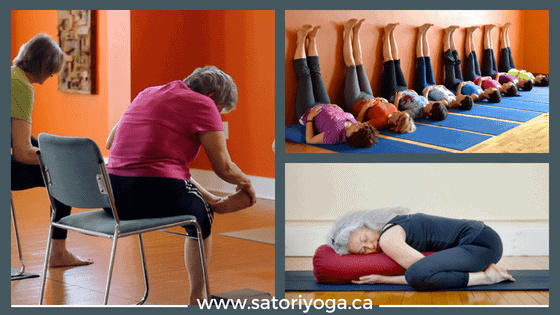
“Julia, I am going to physio, can I still do yoga?”
This question – along with “which class do you think is best for me?” – are among the most frequent questions I get.
I hear these two soooooo often that I hired a graphic designer to create a flow chart to help new to yoga folk navigate the maze of satori yoga classes {watch for this flow chart next week!}
And, this week, after one of satori yogis reached out to say, “hey, my physio just told me not to do yoga,” I thought it is time I’ve addressed the yoga – physio conundrum once, for all, and in writing.
So, does yoga jibe with physio and other modalities?
The short answer is a resounding “YES!”
And testimonials such as “My back doesn’t hurt as bad. Feel great after the class” are the proof in the pudding.
Not convinced?
Here is the long answer:
1. Start with a fact that there is a study, after study, after study, AFTER STUDY that confirm and re-affirm the benefits of movement. That’s why even back surgery patients are encouraged to get on moving almost immediately after their procedure.
Not only human bodies and brains evolved around a variety of everyday movement (something that is on a fast track to extinction in our modern, convenience – oriented lifestyle), we are literally shaped by our daily movements – physically, physiologically, and psychologically.
That is why movement – in conjunction with other modalities – is now considered to be the key factor in recovery. It frustrates me to tears when I hear “don’t do this” comments: not only they hinder the recovery process, they also create fear of movement.
2. Add to that the fact that Pain Care Yoga is a brain child of a physiotherapist who has seen – first hand, so to speak – the limitations of physio-only approach and created pain care yoga practice to fill in the gaps in his clients’ recovery process.
Pain Care Yoga is SPECIFICALLY DESIGNED for folk with persistent pain.
Our pain care yoga success stories are not solely based on what we do in terms of structural approach, but how well we are able to manage, influence and reset the patterns of our nervous system.
Rachael says, “As a result of this practice I feel in control of my breathing, posture, pain, and even thoughts.”
3. For me, physio + massage + acupuncture were the first go-to recovery tools – and for many years. I fully understand (and value!) the incredible benefits they deliver.
Yet my progress {just like many of my now-clients} got stalled and held back by limitations of these modalities.
Research clearly shows that we start making significant gains when we actively engage in our recovery. The trouble with physio, massage and other hands – on modalities is that we become – almost without exception – passive recipients to treatments. We submit to pricks, cracks and manipulations, overtime losing our ability to listen, and most importantly trust our own inner instincts. Our confidence is corroded by dependence on the expertise of our health care providers.
In my own journey, Yoga, Ayurveda, Meditation, Yoga Therapy, Mindfulness, and Pain Care Yoga picked me up and carried me forward where other methods dropped off. These ancient practices filled in the gaps, answered questions, informed, supported and encouraged my recovery in ways that no other modality could, and for a good reason:
Healing begins and ends with self-empowerment.
Yoga, Ayurveda, and Meditation are rooted in this knowing.
Hey, my name is Julia
Over the years I’ve gotten to be pretty good at this problem-solving and silver-lining finding thing.
